

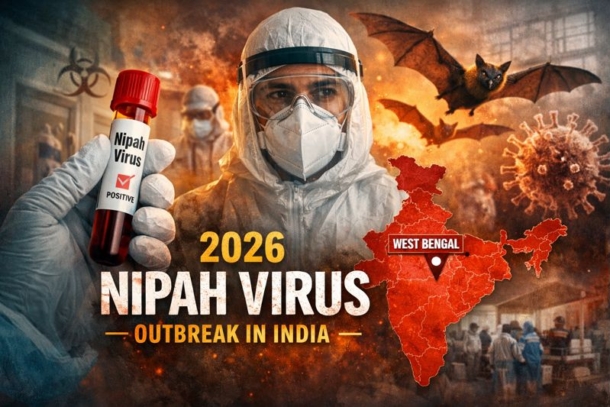
In late December 2025 and early January 2026, the Indian state of West Bengal reported a cluster of Nipah virus (NiV) infections, marking one of the country’s most closely watched zoonotic outbreaks in recent years. The World Health Organization (WHO) and national health authorities confirmed two laboratory-verified cases in the North 24 Parganas district, both among healthcare workers at the same private hospital in Barasat.
What Is Nipah Virus?
Nipah virus is a zoonotic henipavirus — a bat-borne virus transmitted from animals to humans and, in some cases, between people. It was first identified during an outbreak among pig farmers in Malaysia in 1998 and has since caused periodic outbreaks in South and Southeast Asia. The case fatality rate ranges from 40 % to 75 %, and there is currently no licensed vaccine or specific antiviral therapy.
Fruit bats (family Pteropodidae) are the natural reservoir of NiV. Transmission can occur via:
-
direct contact with infected animals or their secretions
-
consumption of contaminated food (e.g., raw date-palm sap)
-
close person-to-person contact, especially in households or health-care settings under limited circumstances
The 2026 West Bengal Cluster
According to WHO’s Disease Outbreak News summary:
-
Two epidemiologically linked cases were confirmed by RT-PCR at the National Institute of Virology in Pune.
-
One case remains critically ill with neurological involvement; the other has shown clinical improvement.
-
India deployed a National Joint Outbreak Response Team to support containment efforts.
-
196 contacts were traced, monitored, and tested; all remained asymptomatic and NiV-negative to date.
Indian authorities stated that the outbreak was timely contained thanks to robust surveillance, laboratory testing, and field investigations — though regional vigilance continues.
Regional and International Response
The outbreak, although limited, has triggered heightened surveillance across Asia:
-
Several countries, including Thailand, Malaysia, Singapore, Nepal, and China, reinstated COVID-style health screenings at airports and borders to monitor arrivals from India.
-
Taiwan’s Centers for Disease Control moved to designate Nipah virus infection as a Category 5 notifiable disease, requiring immediate reporting.
-
The European Centre for Disease Prevention and Control (ECDC) has assessed the current risk to Europeans as very low, given limited cases and no evidence of wider community transmission.
-
The WHO continues to recommend against travel and trade restrictions while emphasizing surveillance and infection control.
Clinical Features and Public Health Considerations
Nipah virus disease typically begins with fever, headache, cough, and respiratory symptoms, which can quickly progress to severe neurological involvement (encephalitis) in a subset of patients. Supportive care remains the mainstay of clinical management.
Because human-to-human transmission outside close care settings is uncommon, large community outbreaks are less frequent than with other respiratory viruses. However, the high mortality rate, potential for nosocomial spread, and lack of specific treatments make early detection and containment critical components of public health response.
Key Takeaways for Public Health Professionals
-
This 2026 West Bengal outbreak underscores the ongoing threat of zoonotic viruses in South Asia and the need for vigilant surveillance systems.
-
Rapid detection, contact tracing, and infection control practices in healthcare settings are essential to prevent secondary transmission.
-
While the immediate risk beyond the region is low, the event highlights the importance of preparedness and cross-border coordination for emerging pathogens.